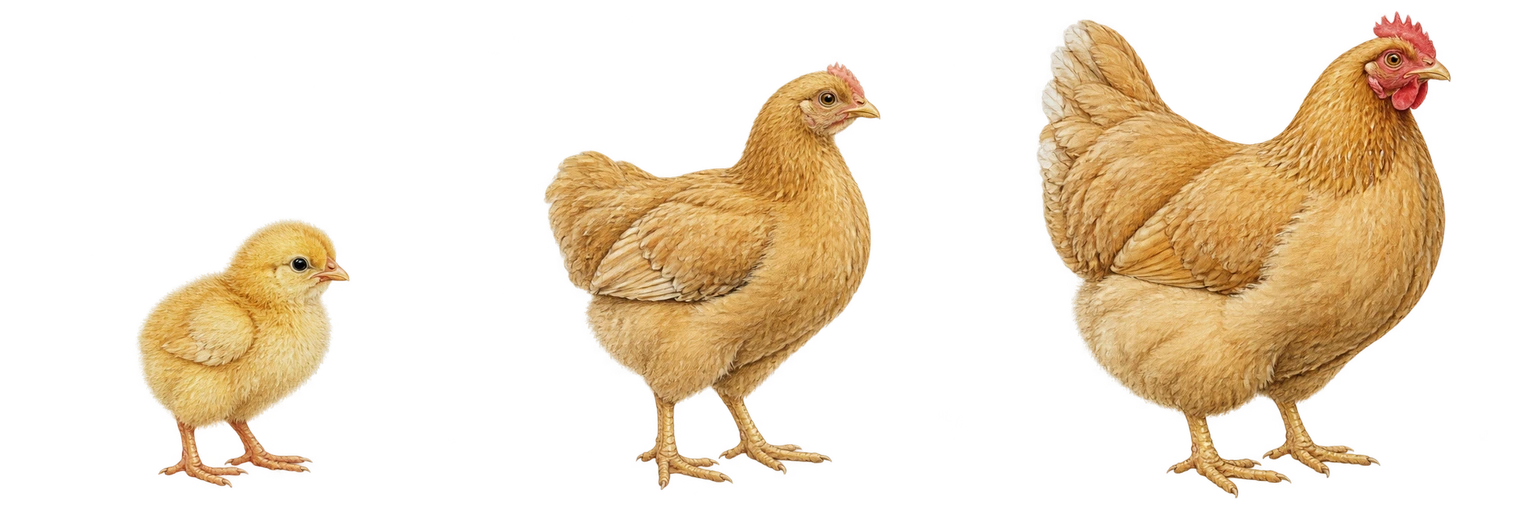
Feeding through life stages
Love Show Flock 22? Start with Show Flock Starter.
A good feeding program starts before the first egg. Choose a family you trust, then use the right feed as your animals grow and their needs change.
For chickens, game birds, cattle, goats and sheep. The right path depends on species, stage and purpose; follow the current bag directions.
In this guide
If you love Show Flock 22 for your laying flock, start your chicks on Show Flock Starter. For best results, Tucker recommends staying within the appropriate product family as you move through the feeds for each life stage. [1]
Start your Show Flock program early
Show Flock 22 is the laying feed’s familiar shorthand; its catalog name is Show Flock Layer 22. Here is the Show Flock Starter catalog’s path for chickens: [2][3]
- Start
Show Flock Starter
From hatch until six weeks of age.
- Develop
Show Flock Developer
After Starter, through the growing period before lay.
- Lay
Show Flock Layer 22
Once the first egg appears.
The Starter directions describe laying age around 18–24 weeks, while the Layer 22 directions use the first egg as the signal. Read the actual bag directions and your flock’s stage together. [2][3]
Layer feed addresses laying birds’ calcium needs. It should not take the place of starter feed for growing chicks just because you like the results in your hens. [5]
One family, different needs
Our recommendation is to think about the whole feeding program, from the beginning. Starting with the family you intend to use gives you a clear next step when growth, laying, finishing or lactation changes the job your feed needs to do. [1]
That is a recommendation to use the family’s appropriate feeds, not to keep feeding one bag forever. A family name does not make its starter, finisher and lactation feeds interchangeable. The animal, the stage and the feeding directions still make the decision. [4]
Find your family’s path
The same approach applies beyond Show Flock. These examples come from Tucker’s published catalog. Each product link opens its full analysis and directions. [4]
Quail, pheasants, turkeys and other game birds
Quail & Game Bird
Begin with Starter. The next step depends on species and whether you are raising birds for eggs, meat or flight. For example, the catalog’s egg-production path for quail and pheasants goes directly from Starter to Layer/Breeder when the first egg appears. A meat or flight program uses Grower after Starter. Turkey timing differs. Follow the species-specific directions rather than the chicken schedule.
Cattle
Tucker Prime
Choose the calf and growing-cattle program for your animals and management. Preconditioner is an option for the weaning transition before Grower & Finisher. Dairy & Lactation serves pregnant or lactating cows. These are choices for different needs; they are not four feeds every animal must eat in order.
Goats
Ultra Premium Goat Feed
Starter & Grower serves growing kids and non-lactating goats. Maintenance & Buck serves bucks and other adult non-lactating goats. Dairy Goat serves lactating does. Choose the next feed by the goat’s current needs, forage and body condition.
Sheep
Pasture Pure
Lamb Creep introduces the young-lamb feeding program. The catalog directs a gradual move to Lamb Finisher at 60 pounds for market lambs. Production Ewe Blend addresses late gestation and early lactation. A ewe’s reproductive program is a different branch from a market lamb’s finishing program.
Make the next step deliberately
- Identify your animal’s current stage and your purpose: growth, eggs, breeding, finishing, maintenance or milk.
- Choose the appropriate product within the family and read the current bag’s directions, warnings and any medication restrictions.
- Make feed changes gradually as directed. Do not assume one transition schedule fits every product.
- Keep the rest of the program in view: clean water, forage where appropriate, minerals and body condition.
For the Show Flock Layer 22 transition, the catalog calls for introducing the new feed over seven days. Other species and products have their own instructions. [3][4]
Love the results from your adult feed? Start the next generation with that family’s starter. Then keep moving with the animal, choosing the right feed for the next stage. [1]
Tell us what you are feeding now, the animal’s age or stage, and your goal. Ask our nutritionist to help map the next step.
Sources
Product examples use Tucker Milling’s published catalog. Follow the current bag directions. Tucker’s family recommendation is a company recommendation, not a comparative feeding-trial result. Extension material explains life-stage nutrition and does not endorse Tucker Milling.
-
Tucker Milling: feeding within a product family ↩
Start chicks destined for Show Flock Layer 22 on Show Flock Starter; use appropriate family products through life stages. This recommendation is not a comparative trial claim.
-
Show Flock Starter: full product information ↩
Starter from hatch to six weeks, then Developer, then the appropriate layer feed.
-
Show Flock Layer 22: full product information ↩
Begin once the first egg appears; introduce new feed gradually over seven days.
-
Tucker Milling product catalog ↩
Quail & Game Bird, Tucker Prime, Ultra Premium Goat Feed and Pasture Pure product names, intended animals and stages. Each product in the guide links to its own full directions.
-
Starter versus layer nutrition and the calcium needs of laying birds. Accessed October 9, 2026.